


Abundance of vegetables
- Bridgette Macilwaine

- Jan 28, 2023
- 4 min read
Planning a variety of vegetables into an urban garden can be overwhelming, we share here how your garden can be a successful veggie patch, with a little soil prep and good planning!

We aimed to use our space wisely to grow as much as possible within the small limited bed we had, and to offer us a variety of vegetables to eat over the coming months.... with a few challenges to consider and lots of physical work to keep us busy..... the fun has just begun!
After thinking through the space and the plant options that might possibly grow well here, we drew up a simple plan - the area that this post is focusing on is the highlighted red square on the plan below.
To learn more about analysing your garden space, designing your urban garden and creating a simple plan as below - Read more here
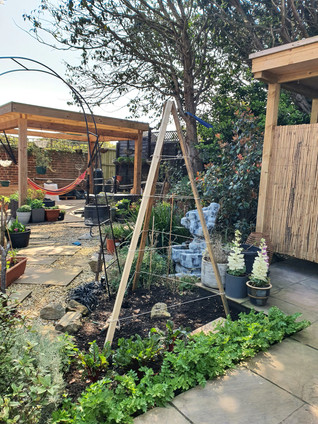
This bed we're focusing on is not very large and as an awkward triangle triangular shape, is approx 2m x 1.1m, with the shortest edge only 70cm across. The other challenge is that the bed also includes a few decorative/structural plants bordering the bed on either side.
The aims for this bed:
prep the bed with compost and other soil improving additives
include a variety of leafy vegetable plants
build a timber frame for the peas
include a longer maturing vegetable between the faster growing choices
ensure there is enough irrigation for the bed

The bed prep
First we started with preparing the bed and the soil, all plants need nutrients to grow well, just like humans need food for bodily functions. The healthier your soil the healthier the organisms living in it will be and the healthier your plants will be. You want to ensure your ground is not compacted and solid, because living soil and plant roots require oxygen, so it might need a little forking over to loosen the ground.
To prepare the soil before planting, we added topsoil and organic peat free compost to the area, other soil additives included:
rock dust - adds countless minerals to feed microorganisms, improves soil pH, water retention capacity, microbial activity, plant health generally
seaweed meal - a 100% natural and organic plant feed and fertiliser, a superb conditioner and helps promote stress resistant, healthy plants and helps to increase soil fertility
used coffee grounds - they contain a good amount of nitrogen, some potassium and phosphorus, plus other micronutrients (the quantity and proportions of these nutrients varies) and can be used as a slow-release fertiliser
crushed egg shells - they provide nutrients for plants, and contain an abundance of calcium, they've been said to reduce the acidity of your soil and help to aerate it


Once the bed was ready, we planted the celery and swiss chard along the paving edge, these were growing elsewhere in pots previously, and then onto building our timber frame for the peas.
There are numerous structures available to buy online or in garden centres, but they can also be quite expensive, whereas this timber A-frame used only 3 pieces of timber, some screws and string, and was dont within an hour.
These were timber lengths from a hardware store - 22mm x 47mm x 2.4m long - approx £5 each.
There was no need to solidly fix them into the ground as this frame wasn't going to hold too much weight, so inserting the timber pieces about half a metre into the ground is good enough in this scenario. The top of the frame was screwed together to keep it strong, and the string used at various heights fixed with a nail around the frame for plants to climb up as they grow.



🌱 Handy tip:
The healthier your soil the healthier the organisms living in it will be and the healthier your plants will be.

The peas were planted first, supported by the frame and string, we had these growing elsewhere until they were big enough and ready to be planted, so garden and crop planning can help you stay organised and be prepared to get your plants in the ground at the correct time (for crop planning advice click here).
It was then time to add in the other plants!
One main point to keep in mind when choosing what to plant next to each other is the root space required and the top crown growth that the vegetable will eventually reach. This can help you understand which plants you can fit into a small space.
In this planted bed:
the peas and a couple nasturtium seedlings planted around the edge of the frame,
within the frame we planted celeriac, as they wouldn't reach too high, but require soil space for large bulbous roots for harvesting,
a row of lettuce to the front of the frame,
a row of radishes behind the lettuces,
one tomato plant to the space on the right so this had room to grow high and branch out,
the celery and swiss chard along the edge of the bed with plenty of room to grow high while we continue to harvest from them.

Then.......with watering and sunshine, everything grew!
The lettuces did well at the base partially shaded by the plants around them, because too much direct sun and heat causing them to bolt and wilt.
Radishes are really easy to grow, they are ready to eat in 4 weeks, but if you want a continual radish supply, you'll need to plan out to have radish seedlings ready to on, by the time you pull the others up.
The swiss chard was huge, you can see it shooting up near the frame, we left it to grow and flower as the insects love it and also we can collect seeds for next year, all the young leaves lower down are still edible while the plant continues to grow.
The peas loved it here, getting a good amount of sunshine and not in a windy position, these were a beautiful purple pod peas, and such satisfaction wandering out at lunchtime to munch on a few fresh peas!
The tomato plant is doing well, although slightly squashed between the large lettuces and the santolina plant, so this areas requires a little maintenance to make sure the tomato has access to sunshine and is being supported with a cane.


Thanks for reading, if this interested you make sure to share with others who are growing vegetables from home, and would love to know your experiences, tips and stories too 🌱


Comments